Table of contents
If your hairbrush is telling a story you do not love, peptides are everywhere in the conversation right now. They turn up in serums, scalp sprays, and injectable protocols, all promising thicker, fuller hair. Some of that is real. A lot of it is marketing. This guide separates the two.
Here is the honest version, and the single most important line up front: no peptide has been shown to regrow hair the way proven treatments like minoxidil and finasteride can. A handful of peptides have credible mechanisms for supporting the scalp and the hair follicle, and the topical ones are easy to get today. None outperforms the treatments dermatologists reach for first, and the most-hyped injectable peptides are not legally available right now while the FDA finishes a review scheduled for July 2026. So this guide ranks what the evidence actually supports, tells you what form each peptide comes in, and shows where peptides fit into a plan that starts with finding out why your hair is changing in the first place.
The numbers
What you are actually choosing between.
Set expectations first
What actually grows hair.
Before any peptide, two facts matter. First, most hair loss has a cause worth identifying. Male and female pattern loss is driven by DHT and genetics. Temporary shedding, called telogen effluvium, is triggered by low iron, thyroid problems, rapid weight loss, illness, or stress. The treatable causes are common and easy to miss.
Second, the interventions with the strongest evidence are not peptides. Topical minoxidil and oral finasteride have decades of trials behind them and remain first-line for pattern hair loss. No peptide has been shown to regrow hair the way these do. Peptides are best understood as adjuncts and early-stage options, not replacements. The topical cosmetic peptides can support scalp health and the growth environment with a good safety profile. The injectable peptides have interesting mechanisms but thin direct evidence for hair specifically, and they sit behind the same 2026 regulatory review affecting the rest of the compounded-peptide market. Keep that framing in mind as you read the rankings.
The honest landscape
Evidence vs. what you can get.
Hair peptides plotted by how strong the direct evidence is against how accessible they are right now. The proven first-line treatments, minoxidil and finasteride, sit top right for reference. They are not peptides. Among peptides, topical GHK-Cu is the best supported and the easiest to get. The injectables are still emerging and not legally available while the July 2026 review is pending.
At a glance
Six peptides, ranked honestly.
| Rank | Peptide | Form | What it targets | Evidence | Availability |
|---|---|---|---|---|---|
| 1 | GHK-Cu Copper tripeptide-1 |
Topical | Collagen, antioxidant, scalp environment | Moderate | Topical now |
| 2 | Thymosin Beta-4 TB-500 |
Injectable | Cell migration and tissue repair | Emerging | Pending Jul 2026 |
| 3 | Tripeptide-1 GHK, copper-free |
Topical | Collagen and micro-circulation | Limited | Topical now |
| 4 | Decapeptide-12 Skin and follicle |
Topical | Cosmetic skin peptide; unproven for hair | Limited | Topical now |
| 5 | Palmitoyl Tetrapeptide-7 Anti-inflammatory |
Topical | Calms scalp inflammation | Limited | Topical now |
| 6 | Pentapeptide-18 Cosmetic neuropeptide |
Topical | Cosmetic (anti-wrinkle); minimal hair evidence | Limited | Topical now |
Ranking reflects the balance of mechanism, direct hair evidence, and how realistically you can use it today. BPC-157 is covered separately below because its hair use is almost entirely anecdotal.
In depth
The peptides, one by one.
GHK-Cu (Copper Tripeptide-1)
GHK-Cu is a copper-binding tripeptide made of glycine, histidine, and lysine that your body produces naturally and that declines with age. In the scalp it is associated with collagen and elastin synthesis, antioxidant activity, and a calmer follicular environment, which is the mechanism most often cited for supporting hair. It is among the best-studied cosmetic peptides for skin and wound healing, and limited experimental and early clinical data suggest it may support the scalp environment, though robust randomized trials demonstrating meaningful hair regrowth are lacking.
Thymosin Beta-4 (TB-500)
Thymosin Beta-4, and its analog TB-500, is a naturally occurring peptide involved in cell migration, tissue repair, and controlling inflammation. The hair logic is that it may help mobilize follicle stem cells and improve the repair environment. The mechanism is genuinely interesting, but direct human evidence for hair growth is minimal, and this is an injectable rather than a topical.
Tripeptide-1 (GHK)
Tripeptide-1 is the copper-free version of the GHK sequence, used in topical formulas to support collagen production and micro-circulation at the scalp. It absorbs easily and is well tolerated. The trade-off is that it lacks the copper that gives GHK-Cu much of its activity, and the hair-specific evidence is thinner.
Decapeptide-12
Decapeptide-12 is best known in cosmetic dermatology as a skin-lightening peptide that works by inhibiting tyrosinase, not through hair biology. Evidence supporting any role in hair growth or follicular IGF-1 signaling is currently very limited, and most real-world use is cosmetic.
Palmitoyl Tetrapeptide-7
Palmitoyl Tetrapeptide-7 is an anti-inflammatory peptide widely used in skincare. For hair, the rationale is that calming scalp inflammation could help protect the follicle, but it is stable and well tolerated but studied far more for skin than for hair, and direct evidence supporting it as a treatment for hair loss remains limited.
Pentapeptide-18
Pentapeptide-18 is primarily a cosmetic neuropeptide used in anti-wrinkle products. It is sometimes proposed to influence follicle signaling, but evidence supporting a role in human hair growth remains minimal, and any effect, where present, is likely modest.
The honest answer
Can peptides reverse hair loss?
Reverse is a strong word. The honest answer is that some peptides may help create a better environment for the hair you have and modestly support regrowth, mostly by improving the scalp, circulation, and the signaling around the follicle. None has been shown to regrow hair the way the question usually implies, and none reverses the underlying genetic process of pattern hair loss on its own.
Where peptides tend to earn their place is alongside proven treatments and after the treatable medical causes have been ruled out. Expecting a topical or an injectable to undo years of pattern loss by itself is the fastest way to be disappointed. Expecting it to support a plan that also addresses the root cause is reasonable.
The one everyone asks about
Where BPC-157 fits.
BPC-157 comes up constantly in hair discussions, almost always on the strength of its tissue-repair and anti-inflammatory mechanisms rather than direct hair trials, which essentially do not exist yet. It has no established clinical role in hair restoration, and the proposed mechanisms, mainly better blood flow and a calmer environment around the follicle, are speculative and based largely on experimental tissue-repair studies rather than hair-specific research.
As an injectable, BPC-157 is also one of the compounds awaiting the FDA advisory review in July 2026, so it is not legally available for this or any use right now. Treat the enthusiasm as a hypothesis, not a result.
The part most guides skip
Start with why your hair is changing.
Hair is downstream of your physiology, and several common reversible causes of shedding can show up in routine bloodwork: low ferritin and iron, an under or overactive thyroid, and, in the right clinical context, low vitamin D or hormonal shifts that affect the follicle. Chasing a topical or an injectable while a low ferritin or a thyroid issue goes unaddressed is how people waste months.
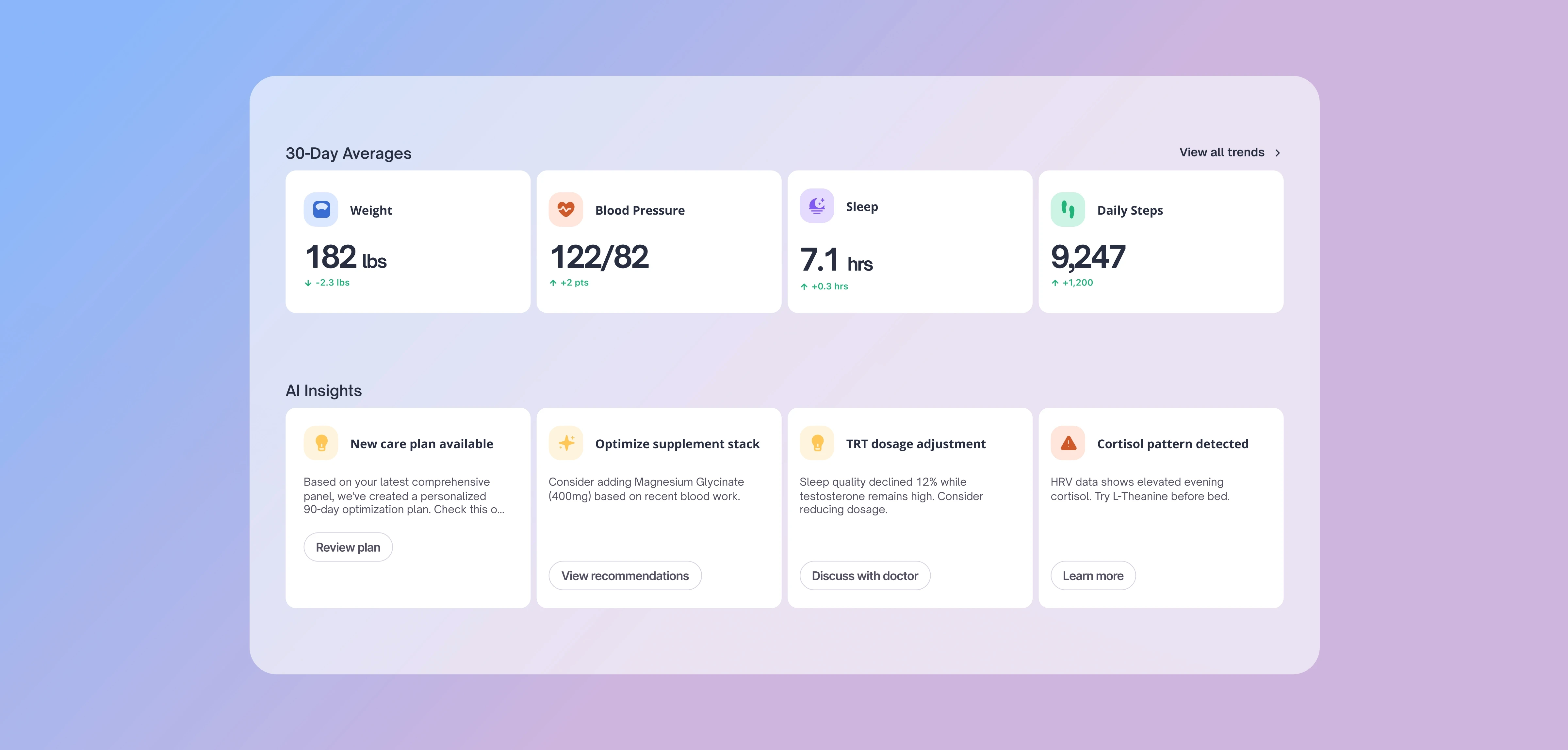
That is the case for measuring first. OneTwenty's membership is built on quarterly comprehensive panels, continuous data from your wearable and connected devices, and an AI coaching layer that reads it together, so a change in your hair gets evaluated against your actual numbers rather than guesswork. Where a treatment is warranted, it is handled by independent licensed providers and the protocol follows the data. The point is not to sell you a peptide. It is to find out what is actually going on before anything gets added.
If you want to try peptides anyway
A sensible way to start.
Start topical
The cosmetic peptides, GHK-Cu, copper peptides, and palmitoyl tetrapeptide-7, are low-risk and available now. Patch test, give it three to six months, and judge the result honestly.
Pair, do not replace
If you have pattern loss, the evidence says topical minoxidil or finasteride does the heavy lifting. Peptides are support, not a substitute.
Be skeptical of injectables sold as available now
The marquee injectable peptides are pending the July 2026 review. Anyone dispensing TB-500 or BPC-157 today for hair is cutting corners.
Rule out the basics first
Ferritin and thyroid function are common, fixable contributors worth checking, and further testing such as vitamin D or hormones should be guided by your history and exam. Ruling these out is the highest-yield step and the one most people skip.
Buy from disclosed, reputable sources
Cosmetic peptide products should list concentrations. Avoid unlabeled vials, "starting at" pricing that hides the real cost, and crypto-only sellers.
Common questions
Hair peptides, answered.
Do peptides actually regrow hair?
Some may modestly support the growth environment, mostly by improving the scalp, circulation, and follicle signaling. The direct evidence is limited, and no peptide has been shown to regrow hair the way proven treatments can. They are best used as support, not as a standalone cure.
Is GHK-Cu good for hair?
GHK-Cu is the best-supported peptide here, mainly on the strength of its skin and wound-healing research. The topical copper-peptide form is available now and well tolerated, and early data suggest it may support the scalp environment, though robust trials showing meaningful hair regrowth are lacking. The injectable form is not legally available while the July 2026 review is pending.
Are peptides better than minoxidil or finasteride?
No. Minoxidil and finasteride have decades of clinical evidence and remain first-line for pattern hair loss. Peptides are adjuncts that can sit alongside them, not replacements for them.
Are hair-growth peptides safe?
The topical cosmetic peptides are generally mild, with skin irritation the main issue, so patch test first. Injectable peptides need a licensed clinician, and most of the popular ones are pending the July 2026 FDA review, so they are not legally available right now. Either way, rule out underlying causes with a clinician before starting.
When will injectable peptides like TB-500 or BPC-157 be available?
Both are among the compounds awaiting the FDA advisory review scheduled for July 23, 2026. Until that review and the guidance behind it publish, they are not legally compounded or dispensed, for hair or anything else.
OneTwenty is a health technology company, not a medical provider, pharmacy, or laboratory. Clinical services are delivered by independent licensed providers, and OneTwenty does not prescribe medication. This article is educational and is not medical advice. Talk to a licensed clinician before starting any peptide, topical, or treatment, especially if you are pregnant, breastfeeding, or managing a health condition.
Fact Checked
Dr. Mohammed A. Fouda, MD
Dr. Fouda is a Neurosurgery research scholar. His work focus primarily on Brain tumor behavior and quality of life of cancer patients as well as biomedical engineering and medical device innovation.



How OneTwenty Works
Not your average
Checkup.
Every life stage brings new biological demands. Tracking the right metrics at the right time helps you adapt, optimize performance, and extend both lifespan and healthspan.
Your Annual Physical
Manual Data Processing
Guesswork Trend Detection
Once-a-year physical
Reactive, tested when sick
No data between visits
Once a year testing
Delayed Results
One-size dosing, set and forget
Real-Time Trend Insights
Daily smart-device data
Automated Data Sync
Quarterly Biomarker Tests
Optimal, personalized targets
Plain-language AI insights
Medications titrated to your data
Built to extend healthspan

Frequently Asked Questions
Clarity before
you commit
Answers on setup, scale, and support to remove blockers.